
Q1-2026 Market Outlook

Key Takeaways in the 2026 Market Outlook
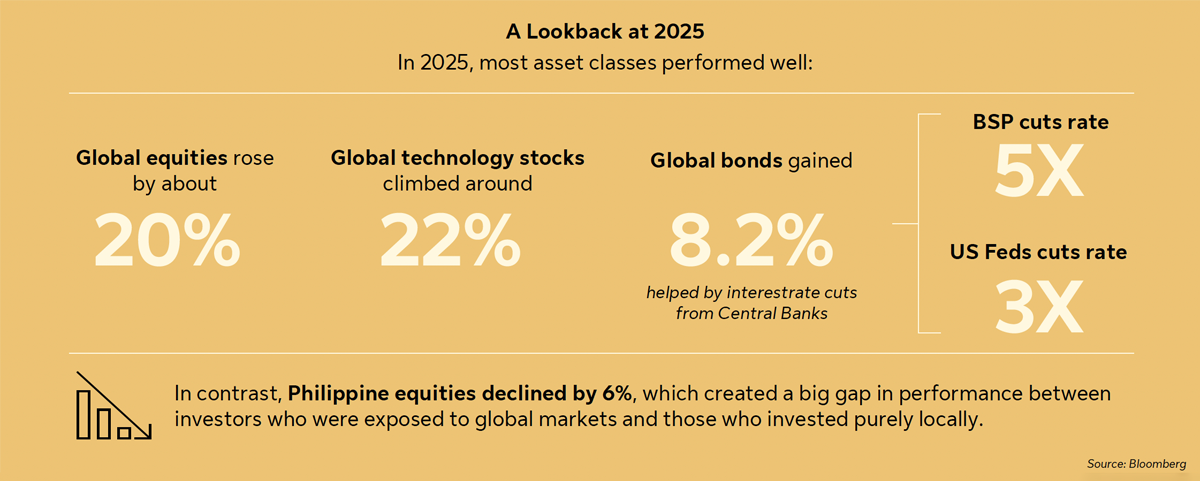
Two Reasons Why the Market Can Still Go Up
1. Artificial Intelligence (AI) remains a major structural theme.
Adoption is still in its early stages - AI is still in the early stages of adoption, which means there is plenty of room to grow. A recent McKinsey* survey shows that:
- 85% of respondents use AI in daily life
- 70% use AI at work
- 92% of companies are already adopting AI
- Only 7% have fully implemented it
These numbers suggest that we are just getting started. As more companies and individuals learn how to use AI, demand for AI products and services will likely continue to grow.
- Use cases are still being discovered - Both companies and individuals are still discovering new ways to use AI. As adoption increases, productivity gains become clearer—benefiting businesses that build and deploy these AI solutions.
- Heavy investment in AI continues - The capital expenditures of the Magnificent Seven continues to rise to an estimated US$ 600 Bn by 2026. This figure is even bigger than the GDP of the Philippines. This shows that companies are allocating more resources into AI as benefits and productivity gains start to become clearer. This spending has benefited other markets outside the U.S., especially Taiwan and South Korea. Other sectors such as utilities, semiconductors and financials also benefit from this spending.
2. Fed may cut rates and lead to positive developments.
The Fed could cut interest rates two times this year, mainly because of lower inflation which registered 2.7% in 2025 versus the current Fed rate of 3.5%. We think there is a lot of room to cut rates (2x), which can bring positive real rates to investors and support the asset prices (both bonds and stocks). We also think that U.S. inflation can go down to 2.5% as labor market settles and housing remains well anchored. For the U.S. market, we're calling only a very low 20% chance of a recession. We think that growth will remain robust in the US and that earnings of US corporations will reflect this healthy economy.
Are we in a Bubble? Dot-com (1990s) vs AI (2020s)
Comparisons are often made between today’s AI boom and the dotcom bubble of the 1990s. However, there is a key difference:
Key Takeaways: In the 1990s, stock prices rose much faster than company earnings. Today, both earnings and prices are rising together.
As long as companies continue to meet or exceed profit expectations, higher valuations can be justified. This may even lead to further rerating of stocks
Low Optimism on Local Markets
The Philippines has only returned 5% for the past 10 years, as opposed to global markets, where we saw double and even triple-digit returns. This poor performance could be attributed to the following:
- Weak Peso
- Thin market liquidity
- Lack of attractive growth themes (tech)
However, we think Philippine equities will not post negative returns again. We think there will be some improvements based on the improving macroeconomic conditions. We expect that GDP will grow from 4.7% estimated this year (2025) to 5.3% next year (2026) and 5.8% for 2027. While there's a lot of room to grow, there are also a lot of risks that we should monitor.
Outlook on PH Inflation
Inflation will stay subdued below 3% in 2026 and 3.3% in 2027, which will help support bonds as the BSP may continue to cut rates by at least two times during the year.
SLIMTC estimates a 2026 year-end PSEi Target of 6,500 Conservative: 5,700 | Moderate: 6,500 | Aggressive: 6,900
We've seen some foreign buying coming in as the prices remain very cheap (now trading at only 9.5x from the 10-year average of 15x). This will remain cheap since most of the listed companies are considered old businesses benefiting from old economies, and the prevailing issue of government corruption and weak investor confidence keeps investment flows subdued.
Risks to the SLIMTC view
- “AI bubble” popping - We think there is a low risk of an AI bubble. Demand for AI products and services are real and it is growing tremendously. Governments are also setting clearer AI rules to mitigate risks. AI usage is boosting productivity among companies that adopt it, boosting profit margins across different industries. AI investments are also largely funded by internally generated capital helping the companies involved keep very manageable debt levels.
- Geopolitical Risks - Geopolitical risks are substantial. Locally, we see corruption that has disrupted the PH economy. In the US, changing policy also affects how companies plan and invest. Tariffs, a new Federal Reserve chair could disrupt markets. Flashpoints like Israel-Iran, Venezuela, Russia, China-Taiwan and South China Sea all pose geopolitical uncertainties that could trigger a market downturn. Therefore, we are monitoring these events quite closely.
- Fed not cutting rates as expected - Falling inflation and stabilizing growth would allow the Fed to ease rates further. However, we've seen in the past where inflation would suddenly go up again especially if there is an external shock. We are cognizant of this risk and are monitoring it closely.
*Sources:
https://www.mckinsey.com/capabilities/tech-and-ai/our-insights/superagency-in-the-workplace-empowering-people-to-unlock-ais-full-potential-at-work
https://www.mckinsey.com/capabilities/quantumblack/our-insights/the-state-of-ai